
Black Long Sleeve Bridesmaid Dresses: Choose the Right Look
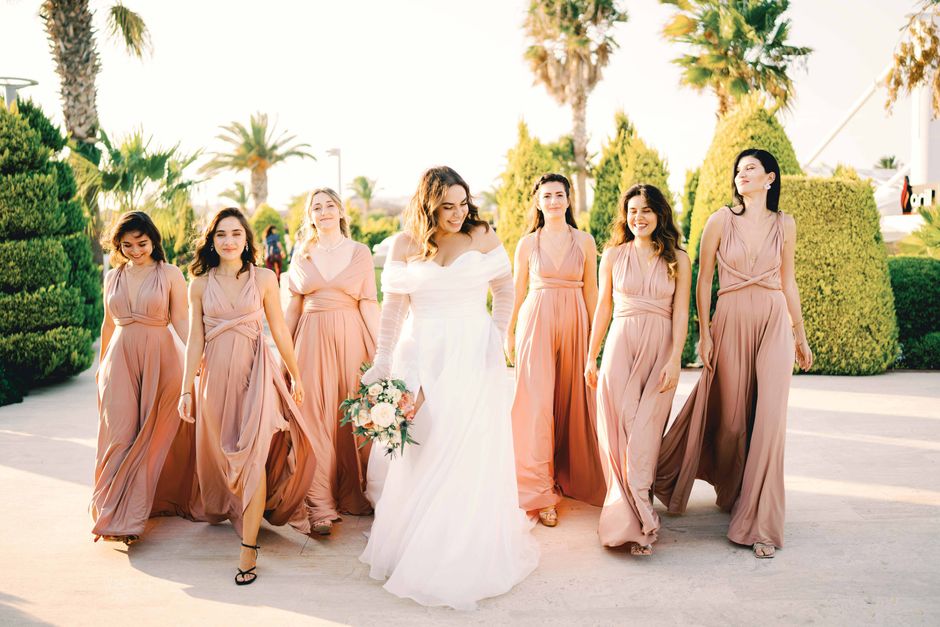
Black long sleeve bridesmaid dresses can suit weddings when the dress code, season, fabric, and styling fit the setting. Choose fabric for the expected conditions, then check sleeve ease, lining, and movement before ordering. To coordinate different silhouettes, keep shared elements such as color and length consistent, and plan accessories and group-photo poses for contrast.
Are black long sleeve bridesmaid dresses appropriate for a wedding?
Yes, black long sleeve bridesmaid dresses are appropriate when they fit the couple’s dress code and the wedding’s setting. Vogue quotes Emily Post’s Wedding Etiquette as saying, “Totally, virtually all colors are acceptable—including black and shades of white.” Bridal stylist Anny Choi also says black can be worn to a wedding.
The color alone does not settle the choice. Vogue’s contributors point to dress code, season, fabric, cut, and styling as factors. The article contrasts black for a formal winter wedding with lighter hues for a sunset beach wedding. That distinction makes the setting a useful first filter: agree on formality and atmosphere before choosing sleeves or silhouettes.
Black gives the bridal party a shared visual anchor. It does not require every dress to have the same neckline or shape. Metallic or accent-color accessories, also suggested by Vogue, can keep the palette from reading as one uninterrupted dark block. For fit and styling considerations specific to dresses with sleeves, see Black Bridesmaid Dresses With Sleeves: Find the Right Fit.
Will long sleeves be too hot for a spring or summer wedding?
Not automatically; comfort depends on the complete garment, not sleeve length alone. The Wilson College of Textiles at NC State identifies moisture management, breathability, heat exchange, tactile comfort, and thermal burden as factors in clothing comfort. For a wedding dress, that points to checking the fabric, lining, and construction alongside the sleeves.
A sheer or lightweight-feeling sleeve does not tell the whole story if the body is lined or the fabric has limited breathability. The sources do not provide temperature thresholds or a season-by-season comfort rating for these dresses. Instead, assess the actual dress and the expected conditions, then arrange a fitting in the undergarments planned for the event.
Ask whether the lining extends through the sleeves and bodice, and whether the sleeve allows easy movement. A long sleeve can feel comfortable when it has suitable ease; a short sleeve can still feel restrictive if the garment binds. The practical decision is to evaluate the whole construction rather than using sleeve length as a proxy for heat.
Which fabrics work best for black long-sleeve bridesmaid dresses in different seasons?
No single fabric is best for every season; compare drape, movement, surface, and care before matching material to the wedding. Colorado State University Extension and the Avenir Museum of Design and Merchandising explain that textile properties affect how a garment looks and feels. Their guide identifies absorbency, drapability, elasticity, and heat conductivity as relevant properties.
Chiffon is described as lightweight, soft, sheer, and relatively strong; it can be made from silk, polyester, or blends. That makes it a candidate when a lighter, flowing look is desired, though the guide does not rank its warmth by season. Check whether the dress is lined, since the visible sheer layer does not reveal the full garment’s feel.
Crepe offers a different balance. The University of Nebraska–Lincoln Extension explains that highly twisted yarn can create a crepe-like fabric with higher elasticity and greater resistance to wrinkling. Its guide also notes that knit fabrics can stretch with body movement. A dress’s actual construction still matters, so check stretch and sleeve ease rather than relying on a fabric name alone.
Satin has luster from long surface floats, but Colorado State’s guide describes it as more delicate and soft, with less durability. Nebraska–Lincoln adds that exposed yarn floats can snag on rough objects. That trade-off matters for a fitted sleeve or a dress worn around textured surfaces. Velvet is a cut-pile fabric; its pile reflects light differently depending on direction, so consistent cutting helps keep its surface appearance even.
The sources do not give season-specific recommendations or prices for these fabrics. Use the comparison as a materials check, then ask the retailer about fiber content, lining, stretch, and care. Textile characteristics depend on fiber, yarn construction, fabric construction, and finish, as Nebraska–Lincoln’s guide notes.
| Option | Who it suits | Cost | Key limitation |
|---|---|---|---|
| Chiffon | Those seeking a lightweight, soft, sheer fabric | Not published | Seasonal comfort rating not published |
| Crepe | Those valuing elasticity and resistance to wrinkling in crepe-like fabric | Not published | Specific dress performance depends on construction |
| Satin | Those seeking a lustrous surface | Not published | Long surface floats can snag; guide describes it as less durable |
| Velvet | Those seeking a cut-pile surface with directional light reflection | Not published | Pile direction affects appearance; pattern pieces need consistent cutting |
How can bridesmaids choose different dress styles while keeping a coordinated look?
Different styles look coordinated when the group shares clear design anchors and the fabrics work together. Texas A&M AgriLife Extension’s Texas 4-H fit standards recommend coordinating fabrics for design, color, weight, and texture. Apply that guidance by choosing a common color and length first, then letting necklines or silhouettes vary within those boundaries.
Keep the comparison simple. If one dress has a high neckline and another a V-neck, a shared length and compatible fabric weight help the group read as one party. If one material has a strong sheen and another is matte, the contrast becomes a visible design choice; it is not automatically a mismatch, but it should be deliberate.
Fit matters across styles. Texas 4-H says clothing should allow body movement, fit smoothly over undergarments, and have sleeves with suitable fullness and length. Necklines and armholes should not gape or strain, and a set-in sleeve needs ease at the underarm and sleeve cap to avoid binding. Set fitting deadlines early enough to check alterations, undergarments, and arm movement in the actual dress.
Photography adds another coordination layer. Professional Photographers of America’s article on wedding photographer Greg Moment describes deliberate posing and lighting as tools for strong portraits; it also notes that arm and shoulder placement can create awkward images and that posing can help avoid unwanted shadows in strong light. Share the dress colors and planned accessories with the photographer, then ask about group placement and poses for the available light. Black can photograph differently across settings, so the plan should account for the scene rather than assuming one result.
Frequently Asked Questions
How do I check whether a long-sleeve dress will fit comfortably and allow arm movement?
Check that the dress has ease through the shoulders and underarms, fits smoothly over the intended undergarments, and does not gap at the neckline or strain at the armholes. Raise and bend your arms during a fitting, and confirm the sleeve length and fullness feel comfortable. Ask about alterations before ordering.
Will black dresses look too severe in wedding photos, especially with black suits?
Black can read as a strong, unified block when dresses and suits are close in tone and the setting has little contrast. Metallic or accent-color accessories, lighter bouquets, and varied but coordinated dress details can help distinguish the group. Discuss pose and lighting with the photographer, since arm and shoulder placement can affect shadows and shape.
What colors of shoes, bouquets, and jewelry look good with black long-sleeve bridesmaid dresses?
Vogue suggests metallic or accent-color accessories with black. A lighter bouquet can bring contrast, especially in a beach setting, while the dress code and formality help guide the overall choice. The sources do not prescribe specific shoe colors.
Sources
Related guides
Black Bridesmaid Dresses With Sleeves: Find the Right Fit
Choose black bridesmaid dresses with sleeves by matching sleeve style, fit, fabric comfort, and formality to the wedding season.
How Do You Choose Long Sleeve Formal Dresses for Weddings?
Choose long sleeve formal dresses for weddings by matching the invitation, season, venue, fabric, length, and comfort needs.

How Do You Choose a Long Sleeve Midi Dress Wedding Guest Look?
A long-sleeve midi suits cocktail or semi-formal weddings when fabric, color, shoes, and layers match the season and venue.

How Do You Choose an Elegant Dress After 60?
Choose elegant dresses after 60 with practical advice on silhouettes, length, fabric, sleeves, fit, and versatility.